
Key Takeaways
- Manufacturers are embracing change with strong investments in AI, automation, and supply chain optimization to drive efficiency and growth.
- Despite 82% expecting production increases, rising costs and economic pressures make proactive planning and technology upgrades critical for competitiveness.
- Cybersecurity and risk management are top priorities, with 75% of companies boosting investment in AI-enabled security to combat evolving threats.
Manufacturers are in a season of change, according to our 2026 Mid-Market Manufacturing Outlook. They’re pursuing a diverse range of growth strategies, making strong investments in technology, and implementing supply chain changes.
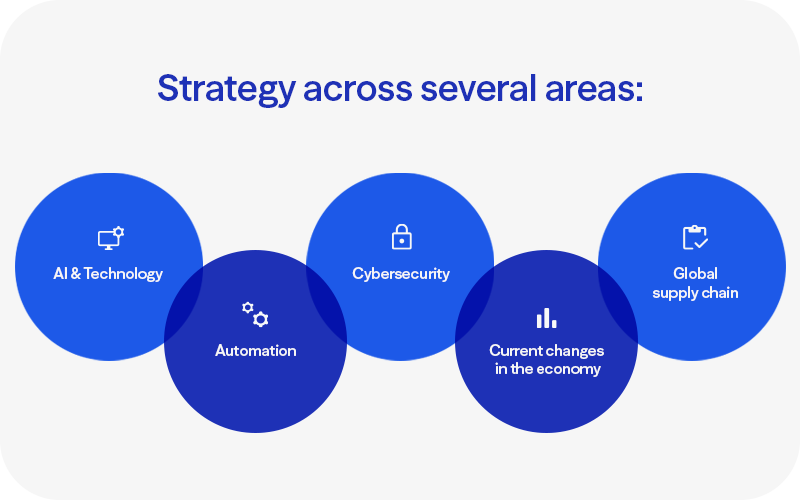
And while most companies (82%) expect to increase production in the next 12 months, 83% also expect costs to rise. To increase efficiency and drive lasting change, manufacturers must adopt a forward-thinking strategy across several areas.
Proactive Planning in Today’s Economic Environment
Inflation and high interest rates stand as two of the top challenges in manufacturing and distribution. And while there’s no way to actively prevent these, there are ways to proactively plan and develop competitive operational advantages.
Recent legislation — specifically the One Big Beautiful Bill — has made domestic investment even more compelling. This impact is reflected in our 2026 survey, where over 24% of manufacturers and distributors are near-shoring or reshoring production and sourcing — almost twice the percentage from last year’s report.
Before committing to reshoring, it’s important for manufacturers to think proactively — and long term — about their organization and its needs. After all, strategic domestic supply chain investments can take years to plan and develop.
Things to consider include:
- How and where are your products being sourced?
- How are your products being distributed?
- How will a location change impact your organization?
Reinvigorate Your Supply Chain Strategy
One-third of manufacturers cite significant supply chain challenges, including:
- Rising transportation costs.
- Supply delays.
- Trade disruptions.
Much of these are due to cost increases. More than half of respondents note production continues to rise alongside both foreign and U.S.-sourced component costs. Transportation and freight costs also showed an increase with 31% of respondents noting significant increases and 45% citing at least somewhat of an increase.
In response, manufacturers and distributors are focused on optimizing efficiency, minimizing cost, reshoring/nearshoring, and using more AI and machine learning to manage their supply chain.
What changes has your company made to its supply chain in the past year?
| Expanded the number of suppliers that we work with | 32% |
| Used more artificial intelligence (AI) and machine learning (ML) to manage supply chain | 32% |
| Did more scenario planning and risk management | 29% |
| Improved our end-to-end supply chain visibility | 28% |
| Upskilled/reskilled our current workforce | 28% |
| Consolidated the number of suppliers that we work with | 28% |
| Optimized our inventory management strategies | 27% |
| Redesigned products and/or processes to reduce supplier components and materials | 26% |
| Tightened supplier audits and selection criteria | 26% |
| Digitized our supply chain management processes | 24% |
| Nearshoring or reshoring | 21% |
| None of these | 3% |
Skin Script Scales with Smart Technology
Skin Script, a fast-growing skincare manufacturer and distributor, faced challenges with inventory management, financial planning, and operational agility. Partnering with Eide Bailly, they implemented a custom cloud-based ERP solution integrated with advanced inventory and automation tools.
Results:
- Tripled order volume without adding headcount or warehouse space
- Gained real-time inventory visibility and streamlined financial planning
- Improved agility to respond to market changes and scale efficiently
Skin Script’s story shows how the right technology, guided by Eide Bailly’s manufacturing guidance, can overcome labor constraints, boost productivity, and achieve sustainable growth.
The Rise of AI and Automation
Technology-related opportunities are top of mind for manufacturers and distributors, including:
- New technology deployments (39%).
- Upgrading machines (32%).
- Increased use of artificial intelligence (31%).
- Increased focus on cybersecurity and data privacy (31%).
While 74% of companies are planning to increase their investment in AI within the next year, the top growth strategy is updating existing technologies. This aligns with what we tell clients: the strongest AI implementations are often not the flashiest. Focus on embedding AI into core systems like ERP and MES to drive predictive maintenance, scrap-rate anomaly detection, and tariff impact modeling.
After all, the best AI integrations run on solid, structured data. And with only 26% completely agreeing that their technology is up to date and only 39% completely agreeing their current systems and machines are AI-ready, there’s still work to be done.
Dive Deeper:
- Elevating Manufacturing Strategy with Integrated Data
- How to Get Your Manufacturing Organization AI-Ready
The Role of Automation
A digitally optimized manufacturing facility can reduce manual tasks and shorten equipment downtime. Automation can speed up traditional processes and allow manufacturers to future-proof their operations.
That’s why machine upgrades, automation, and robotics are all top of mind for survey respondents:
- 71% of company leaders will increase investment in industrial automation and robotics in the next year.
- 71% will increase investment in smart machines and the Internet of Things.
- 61% completely or mostly agree that their companies are upskilling and reskilling their employees in the latest technologies.
The Impact of Risk
With the rise of new technologies comes an increase in potential cyber-attacks. One in five companies report that cybersecurity is a top challenge. And 75% of companies will increase investment in cybersecurity technology and automation, compared with just 25% in 2025.
Criminals may use AI to perform faster and trickier data breaches, but you can also use it to thwart those attempts. It starts with performing a security threat assessment on the current system.
Manufacturers should look for:
- Completion of cybersecurity training by employees.
- The number of threats detected and the response time to them.
- The number of unsuccessful login attempts (a sharp spike in this number may indicate an attempted breach).
From there, AI-enabled security tools help close any gaps and secure the system against attacks. The best framework for implementing cybersecurity measures is SOAR (Security Orchestration, Automation, and Response), which gathers security-related information from various sources in the organization, analyzes the data, and implements automated responses to potential threats.
What’s Next for the Manufacturing Industry
Almost 80% of executives feel confident they are prepared to pursue growth strategies in the coming months, including updating existing technology or acquiring a company. And while you might not be able to predict what new trade policies or legislative shifts are coming, you can take strategic, proactive steps to be prepared.
Manufacturers who routinely review their processes, digitize their supply chain, and keep an eye toward efficiency will be ahead of the competition going forward.
Eide Bailly provides strategies to build resilient supply chains, optimize costs, and embrace reshoring for long-term success. Connect with our manufacturing advisors today to discover how data-driven strategies, advanced technology solutions, and industry expertise can help your business optimize efficiency, minimize risk, and stay ahead of disruption.
Contact Eide Bailly Manufacturing Advisors | Access the 2026 Manufacturing Outlook Report
Frequently Asked Questions
What are the top supply chain challenges for manufacturers in 2026?
Manufacturers cite rising transportation costs, supply delays, trade disruptions, and increased costs for both foreign and U.S.-sourced components as top challenges. Many are responding by expanding supplier networks, investing in AI, and scenario planning.
How are manufacturers using AI and automation to improve supply chains?
Companies are embedding AI in ERP and MES systems for predictive maintenance, anomaly detection, and tariff impact modeling. Automation and robotics are reducing manual tasks, improving visibility, and future-proofing operations.
What is agentic AI and why does it matter for manufacturing?
Agentic AI refers to autonomous systems that can sense, plan, and act to mitigate supply chain risks — such as monitoring disruptions, recommending alternative suppliers, and initiating mitigation steps with human approval. This technology is key to building resilient, adaptive supply chains.
How are companies addressing supply chain risk and cybersecurity in 2026?
Manufacturers are investing in SOAR frameworks (Security Orchestration, Automation, and Response), employee training, and AI-enabled security tools to detect and respond to threats. Cybersecurity is now a top investment priority for 75% of firms.
2026 Mid-Market Manufacturing Outlook Report
Manufacturing, Distribution, and Logistics
Rely on the trusted expertise of manufacturing advisors to help you build and execute your strategic vision.
Who We Are
Eide Bailly is a CPA firm bringing practical expertise in tax, audit, and advisory to help you perform, protect, and prosper with confidence.
